

In Scripture, there are two notable Innkeepers, two stories where an Inn Keeper plays a hidden yet significant role: at the birth of the Christ Child and in the parable of the Good Samaritan. These stories, though separate, converge in a profound way, offering insight into Jesus’s invitation for us and the role he asks us to play. Let’s take a closer look.
The concept of an “Inn Keeper” is the first clue. An inn is a temporary dwelling—a place of rest, but not a home. It serves a purpose, creating a space for people to come and stay for a time, yet ultimately, they move on. Doesn’t that echo our mortal probation? Here, in this mortal journey, we’re stewards over the “inn” of our lives. We care for it, welcome others in, and witness people coming and going, while living in a temporary state.
In Luke 2, at the first Inn Keeper, we may say he missed the single greatest opportunity of all time: to host the birth of the Christ Child. Imagine if he had accepted Mary and Joseph! His humble inn could have been transformed forever—a site held sacred for millennia. But it was not meant to be. God’s purpose was fulfilled in a stable, a place formed from rock, untouched by human design. Which aligns with Gods instructions to man when building altars that only unhewn stones be used, natural and not manipulated or changed by man. The Christ Child being born in a stable was both purposeful and appropriate for His birth.
Yet, God still has a message for us. We’re invited to be innkeepers who do not turn Him away by not turning others away. To accept Jesus into our “inn” is to welcome others into our lives, even as we dwell in this temporary, mortal sphere. The innkeeper’s role is one of service—of opening the door and saying yes to whatever God may ask. Jesus said, “Whatever you do to the least of these, you do it to me.” But how can we accomplish this when we feel as the innkeeper did? There is no room! Our resources feel exhausted, our time is scheduled down to the second, and we’re already serving and hosting a full house. We may wonder, “How can I do more? Who am I to let in?”
This brings us to the second Inn Keeper. A similar question was asked of Jesus, “Who is my neighbor?” His response to this question was the parable of the Good Samaritan.
Jesus begins, “A man went down from Jerusalem to Jericho and fell among thieves.” Jerusalem means “a place of peace,” which could represent Heaven. And Jericho, or city of the moon, gives a nod back to creation when God stated that the moon or lesser light rule the Earth. Without going into to much detail this points us to our mortal journey we are temporarily experiencing. The thieves represent the adversary in which all of us will face which “stripped him of his raiment, and wounded him, and departed, leaving him half dead.” This imagery is symbolic of the trials that we all will face in this life to differing degrees and variance.
A priest passes by; a Levite does too. They see the man but do not stop. Priests, were revered as intermediaries between man and God, seen as absolutely necessary in relationships to God. Levites, were given special religious rites in sacrificial rituals and duties, including administering to cities of refuge. However they passed by, when it seemed their godly duty. So what is Jesus teaching us in this parable?
The parable continues with the Samaritan—a member of the House of Israel, yet rejected by the Jews, regarded as a “half-breed” and often scorned. This unlikely figure becomes the one who does not pass by. Moved by compassion, the Samaritan stops: “And went to him, and bound up his wounds, pouring in oil and wine, and set him on his own beast.”
The Samaritan does what the others would not, as Jesus does for us what no one else can. “He heals the brokenhearted and binds up their wounds” (Psalm 147:3). His pouring in of oil and wine mirrors the suffering and sacrifice in Gethsemane and on the Cross—an act that neither priest nor Levite, though symbolic of holiness, could ever fulfill as He has. The Samaritan then sets the man on his own beast—a symbol echoing Mary’s journey to Bethlehem and Christ’s entry into Jerusalem in His final week. That which once carried Him is now given to carry us forward.
The Samaritan, of course, is Jesus, who after binding his wounds takes the man to the Inn and takes care of Him for a time. However, when the morning comes and the darkness has passed, He departs but not without instructing and blessing the host, or Inn Keeper. “And on the morrow when he departed, he took out two pence, and gave them to the host, and said unto him, Take care of him; and whatsoever thou spendest more, when I come again, I will repay thee.”
Jesus, the Good Samaritan, calls us to be the innkeepers—the ones who care for those He brings into our lives. He saves and nourishes those in need, then knocks on the door of our own “inn” and invites us to join in His mission of saving souls. “Behold, I stand at the door and knock: if anyone hears my voice and opens the door, I will come in to him, and will sup with him, and he with me” (Revelation 3:20).
Who are we called to make room for in our inn? Who is our neighbor? We can’t possibly host every person we encounter along life’s path, but He doesn’t ask us to. He asks us to welcome those He brings to us. So let us be innkeepers who can discern and aware, hearing the knock and eagerly opening the door, joining in this sacred work of saving souls.
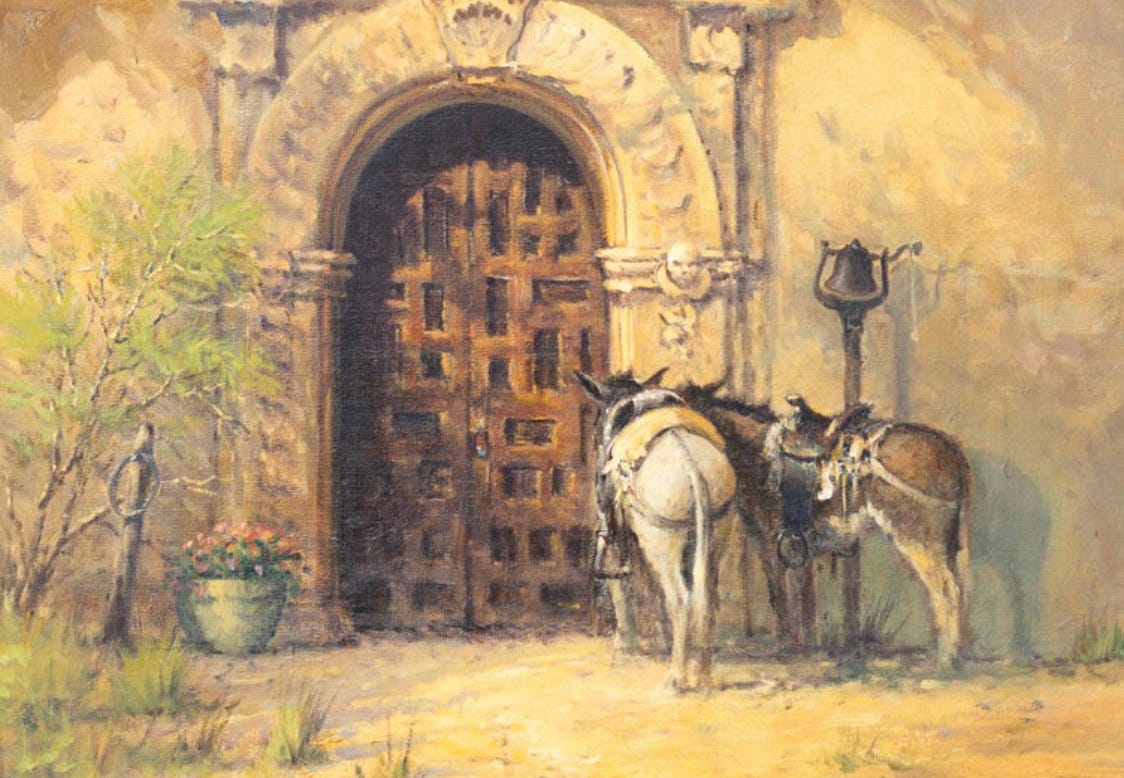
*Painting “Pasientes” by G. Harvey